Your First Salary in Japan: Take-Home Pay, Spending Breakdown, and How to Budget
 Kona5 min read
Table of contents

Your first payday in Japan is exciting until you compare the gross amount on your pay slip to what actually landed in your bank account. The gap is real, and it's caused by social insurance premiums and income tax. Here's how to understand that gap and build a monthly budget around what you actually take home.
The bottom line: take-home is 75–85% of gross
Japan's average starting salary for university graduates was ¥248,300 per month in 2024, which translates to roughly ¥190,000–210,000 in take-home pay (Ministry of Health, Labour and Welfare, 2024 Basic Survey on Wage Structure). The most popular use of a first paycheck is savings (37.4%), followed by a gift for parents (36.6%), according to a 2025 Job Research survey.
A simple starting framework: split your take-home into savings (20%), fixed costs (50%), and discretionary spending (30%). No detailed tracking required.
What does a starting salary look like in Japan?
According to the Ministry of Health, Labour and Welfare's 2024 Basic Survey on Wage Structure, starting salaries for new graduates were:
| Education level | Monthly gross | Year-on-year |
|---|---|---|
| Graduate school | ¥287,400 (~$1,900) | +4.1% |
| University | ¥248,300 (~$1,650) | +4.6% |
Source: MHLW 2024 Basic Survey on Wage Structure
Using the ¥248,300 university graduate figure, here's what gets deducted before anything reaches your bank account:
| Deduction | Approx. monthly amount | Notes |
|---|---|---|
| Health insurance | ~¥12,000 | Varies by prefecture and insurer |
| Employees' pension | ~¥22,700 | 9.15% of standard monthly pay (employee share) |
| Employment insurance | ~¥1,500 | 0.6% in FY2024 |
| Income tax | ~¥5,000 | Depends on dependents and tax tables |
| Residence tax | ¥0 | Starts in June of year 2 |
| Total deductions | ~¥41,000 | |
| Take-home | ~¥207,000 |
The first time you see a Japanese pay slip, the deductions can feel like a shock. But here's the silver lining: residence tax (住民税) doesn't kick in until June of your second year, so your first-year take-home is actually the highest it'll be for a while. Expect it to drop by another ¥10,000–15,000 per month when that hits.
Caution
Some companies don't withhold social insurance premiums in the very first month, making your initial paycheck slightly higher than normal. Budget based on month two onward to avoid surprises.
What do new grads spend their first paycheck on?
A 2025 Job Research survey of 123 new employees in Japan found these top uses for a first salary:
| Use | Share |
|---|---|
| Savings | 37.4% |
| Gift for parents | 36.6% |
| A treat for themselves | 25.2% |
Source: Job Research "2025 First Salary Survey"
Savings and gifts for parents run nearly neck and neck. Taking your parents out for a nice meal with your first paycheck is a classic tradition in Japan, and the data shows more than one in three actually do it.
The other shift worth noting is investing. A Money Forward survey of 1,000 app users aged 22–26 found a sharp divide depending on when people entered the workforce.
Source: Money Forward press release (April 2026)
That's roughly a 3.6x jump in just a few years. Japan's tax-free NISA accounts have clearly changed the playbook. That said, building an emergency fund (roughly three months of living expenses) before investing is the safer order of operations. To work out a realistic monthly savings amount from your take-home pay, see how much to save in your first year working in Japan.
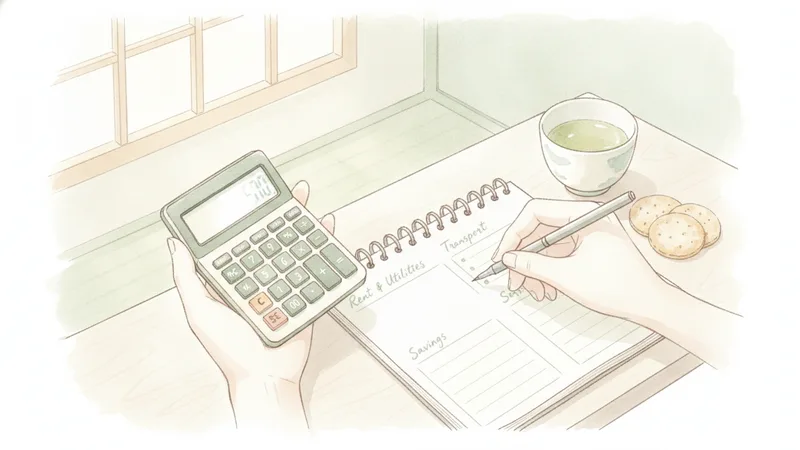
How to budget: the 3-way split
Even if you know what you want to spend on, "I'll save whatever's left" almost never works. The 3-way split gives you guardrails without the hassle of detailed bookkeeping.
| Category | Share | On ¥200,000 take-home | What's included |
|---|---|---|---|
| Savings & investment | 20% | ¥40,000 | Auto-transfer to savings, NISA contributions |
| Fixed costs | 50% | ¥100,000 | Rent, utilities, phone, subscriptions |
| Discretionary | 30% | ¥60,000 | Food, socializing, hobbies, clothes, daily needs |
Budget tip
Set up an automatic transfer on payday to move 20% into a separate account. If you wait to save "whatever's left," there's almost never anything left.
If your fixed costs already eat more than 50% of take-home, that's the first thing to attack. Switching to a budget phone plan (MVNO) or canceling unused subscriptions can free up several thousand yen a month. For a deeper look at trimming fixed costs, see the guide below.
 Related readRealistic Money-Saving Tips for College Students (Start With Fixed Costs)
The big variable within that 30% discretionary bucket is social spending. How much goes to dinners and drinks with coworkers or friends shapes everything else.
Keeping social spending under control
Within your ¥60,000 discretionary budget, aim to keep social spending around ¥15,000–20,000 per month. That leaves room for hobbies, clothes, and daily needs.
- Set a monthly cap: three outings at ¥4,000–5,000 each is a practical ceiling
- Record shared costs on the spot: if someone fronts the bill, log the amounts right away, because untracked IOUs tend to stay unpaid
- Mix in low-cost options: swap every other izakaya night for a home gathering or park lunch to cut the average in half
Welcome-party season for new employees is when social spending can spiral. You might expect a senior colleague to cover the tab, only to find out it's an even split. That's just how it goes sometimes.
When one person pays for the whole group and collects later, the exact amounts tend to get fuzzy over time. Nobody wants to be the one chasing people down weeks later. Logging costs with a splitting app right when they happen avoids the awkwardness entirely. If larger sums move between friends and you're curious about the tax side, Japan's gift tax rules and group expense splitting covers the key points.
FAQ
Q. Is it normal for take-home pay to be much lower than gross?
Yes. In Japan, take-home is typically 75–85% of gross salary. For a university graduate earning ¥248,300, that means roughly ¥190,000–210,000 after social insurance and income tax. The gap is standard and not a payroll error.
Q. How much should I save from my first salary?
A practical starting point is 20% of take-home pay. On ¥200,000, that's ¥40,000 per month. If that's too tight, start with ¥10,000 and automate it on payday. The habit matters more than the amount.
Q. When does residence tax start in Japan?
Residence tax (住民税) is based on the previous year's income, so new graduates pay ¥0 in their first year. Deductions begin from your June paycheck in year two, reducing take-home by about ¥10,000–15,000 per month. Setting your lifestyle slightly below your year-one capacity makes the transition painless.
Wrapping up
The most important thing about your first salary isn't tracking every yen. It's setting the big three buckets and automating the savings transfer before you have a chance to spend it.
Decide on a social spending cap before the invitations roll in, and log shared costs as they happen instead of leaving them vague. The residence tax hit in year two is real, so living slightly below your means in year one is the smartest gift you can give your future self.
This article provides general information and is not intended as individual tax advice. If you have specific concerns, consult a tax office or licensed tax advisor.
Related articles
Money Tips
How Much Can You Save in Your First Year Working in Japan? A Data-Driven Guide
July 4, 2026
Money Tips
How Much Is Your JASSO Loan Payment? A Realistic Repayment Plan for New Graduates in Japan
July 4, 2026
Money Tips
How Much Should You Budget for Oshikatsu? A Money Guide for Fans in Japan
July 4, 2026